Cup
It is a small vase (h=37.5 mm; max. d.=80 mm) 23, weighing 155.7 g. It is cylindrical in shape and equipped with a ring base. The actual cut and the foot were executed separately, then welded.
The ring foot is externally concave and slightly oblique internally; similarly, the base of the foot is slightly inclined inward. In the middle, the foot presents a protrusion on the side with very slight relief, delineated by a groove and a concentric incision; a hollow point marks the center of the disc. It would not be excluded that the foot was made by finishing, after an initial turning operation on the lathe.
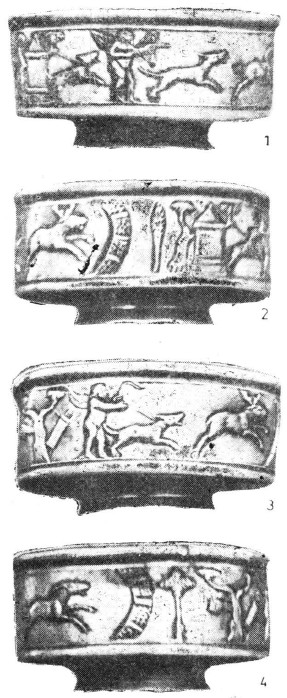
The body of the cup was made by separate rolling and hammering of the base and the cylinder, after which they were welded together. The lip, which has been bruised and cut in places, is thickened and rounded outward. Just below the lip, there is a fluting beneath which a decorative register unfolds, delimited at its lower part by a fluting similar to the first. The decor is of a Bacchic nature and is divided into two large segments by semicircles concave to the left. The semicircular separation arcs, probably to suggest walls, have their relief slightly inclined to the right. At approximately equal distances, three transverse edges divide the decoration into four sectors; within each zone, by hammering with a fine tool with a square tip, a reticulated decoration was achieved that perhaps imitates construction elements.
Since the two main scenes of the decor do not seem to be arranged in a logical sequence, we will begin the description from one of the semicircles and continue it in the direction of the subjects' movement, that is, from left to right. The register that is thus considered the first includes the following elements: two trees from warm countries, then a Cupid with a dog chasing a deer. The first tree - which could be a palm tree - is slender, with a cruciform crown; its foliage is rendered realistically through punctures and incisions. The second tree, made using the same technique, differs from the first in that it has a large trunk and a branched crown (it might be a sycamore). On its left branch is attached a syrinx, decorated on its board with a row of three dots representing rivets. On its right branch hangs a roughly cylindrical quiver, which reveals the upper part of the arrow bundle; the quiver is decorated with a horizontal incision at each of its ends and, in its middle part, with two oblique and parallel incised lines. Eros has his usual appearance of a chubby child, with a schematically rendered face and slightly wavy hair; his only visible wing is divided by incised lines into 5 segments; the feathers are suggested by dots and fine incisions; he holds in his left hand an object that could either be a stylized thyrsus or a torch with the flame directed in the direction of his movement; in his right hand, he holds a dog on a leash. This one, depicted in full motion, with its front legs raised, ears laid back, and mouth open, expresses momentum and strength; its collar is adorned with two dots representing ornamental studs; its fur is rendered roughly with a few punches. The last element of this segment is a deer in full run, with its mouth open and its front legs raised very high; its hooves and fur are rendered by incisions and punctures. In several places - in front of the first tree, between the trees, between the tree and Eros, under the dog, under the deer - the artist has made some incisions suggesting tufts of grass.
The second decorative panel also begins with a tree; its slender shape and pyramidal crown allow it to be identified as a cypress. A second tree, similar to the sycamore in the first register, is partially obscured by a cippus, or rather by a cylindrical funerary urn with a double prismatic base and covered with a conical lid with a knob; the upper left corner is obliquely connected to the lower right corner by two parallel rows of dots. On the right branch of the last tree, a dog is tied with a leash; with its head pulled back, mouth open, ears laid back, and front paws raised high, the animal intensely participates in the hunting scene unfolding before it; its fur and certain anatomical elements are always represented by incisions and punctures; its collar is decorated with two small dots representing rivets or nails. In front of the dog stands a second Eros, similar to the first, but holding a bow with an arrow that he is about to shoot. In full run, with its front legs raised, head thrown back, and mouth slightly open, a second dog chases an animal that, according to several researchers, would be a gazelle; this animal is also depicted in full run, with its front hooves raised high, snout wide open, and head thrown back; its horns, slightly rounded, almost reach its back, whose specific parallel stripes for this species are rendered by incisions; the fur of these last two animals is again depicted here by punctures. The vegetation is suggested by dots under the three animals and in front of the gazelle.
On the foot of the vase, between the discoidal protuberance and the base, the letter B can be seen, marked by dots. This letter has been interpreted as an indication of the weight of the vase or as the title of the silver that goes into its alloy. In this case, the symbol in question could represent half a pondus ( = 327.45 g), that is, 163.745 g, a figure close to the weight of the cup, which is 155.7 g.
Quantity
1
Weight
155.7 g
Length
3.75 cm
Diameter
8 cm
Start Year
1
End Year
300
Material
Silver
Hoard